
The first thing you notice in Lookbook 07 is the pale dress. The gold-coloured details arrive a moment later: a line at the waist, a curved bracelet, the handle of the bag and the narrow straps across the shoes. They are small enough to let the dress remain the main shape, but repeated enough to make the combination feel connected.
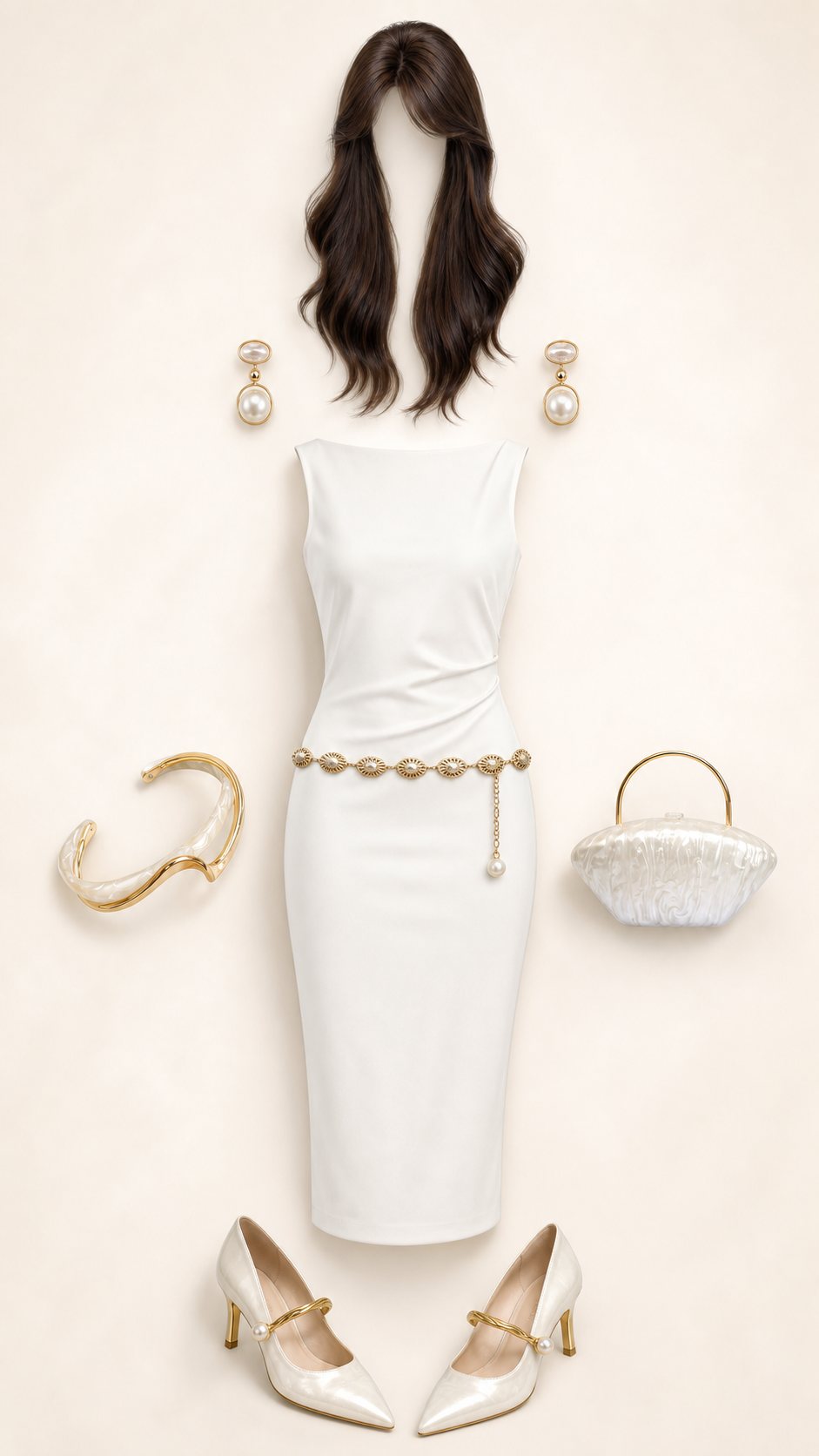
This article looks at the styling illustration in the Your Doll Stylist Lookbook 07 delivery package. It explains the visual arrangement shown there; it is not a record of a physical fitting on a particular doll.
Let the dress establish the line
The board shows an ivory-toned sleeveless dress with a fitted outline and folds gathering toward one side of the waist. Its relatively uninterrupted lower section gives the eye somewhere to rest after the detail around the middle.
That is the starting point for reading the accessories. They do not need to supply another large field of colour. Their role is to pick up details of the dress and mark particular places along its line.
If you are using this direction as a reference, describe the features separately: pale colour, a close outline, a visible waist and a mostly clear skirt. Those priorities are more useful than asking for “an elegant white dress” and hoping the rest follows.
Use warm metal-coloured details as a connecting thread
The belt, bracelet, bag handle and shoe details repeat a warm gold tone. Their shapes are different, so the repetition does not depend on every accessory belonging to an identical jewellery set.
The belt makes a horizontal line at the waist, with a hanging pearl-like detail giving it a vertical finish. The bracelet is broader and more sculptural. The bag handle is a clean curve. Together, they give the pale outfit several points of contrast without introducing a second dominant colour.
Metal colour on a styling illustration is a visual description, not a claim about composition or plating. For an actual order, use the product information to establish those details.
Read the pale accessories by their shapes
The rounded earrings, shell-shaped bag and pointed shoes all remain close to the dress’s pale palette. They are still distinguishable because their outlines and surfaces differ.
This is useful when a low-contrast outfit starts to look flat. You do not always need a bright accent. A curved handle, a pronounced toe shape or a different surface can create a detail the camera reads while keeping the overall colour direction quiet.
On this board, the dark wavy hair supplies the largest contrast. It frames the upper part of the composition and makes the lighter earrings easier to identify. In a worn view, hair placement would need checking against the neckline and shoulder area.
Keep the waist detail visible
The waist line is one of the most specific parts of this combination. A bag held directly in front of it could conceal both the folds and the belt. Hair falling forward could also add more visual weight above it.
For a photograph inspired by this board, start with a clear view of the dress and waist. Then decide where the bag and hair belong in the frame. The board itself separates the pieces for explanation; a worn photograph needs to show how they overlap.
The outfit proportion guide can help you assess those relationships without treating a styling illustration as a fit test.
What each visible detail contributes
| Detail on the styling board | Role in the composition |
|---|---|
| Ivory-toned fitted dress | Establishes the main colour and body line |
| Dark wavy hair | Frames the upper part of the Look with contrast |
| Pale drop earrings | Repeat the light palette near the face |
| Gold-toned waist chain | Defines the middle and adds a hanging detail |
| Sculptural bracelet | Adds a broader curved metallic accent |
| Shell-shaped bag | Introduces a rounded shape beside the dress |
| Pale pointed shoes with metallic details | Carry the palette down to the feet |
Translate the direction with the right information
To develop a similar direction for your doll, send the board as a reference and say which features matter most. You might want to preserve the pale palette and waist detail while asking about the practical clothing options available.
The actual selection needs the relevant dress, waist-accessory, wig and foot measurements. The illustrated arrangement cannot establish garment openings, compatibility, support requirements or exact colour under your lighting. Our measurement guide is a useful starting point.
For a ready-made purchase, check the current complete Look page and its inclusion list. For a direction based on this illustration, use Find the Look and identify the details you want to keep. The strongest part of this reference is specific: a pale dress, a readable waist and small warm accents carried through the outfit.