
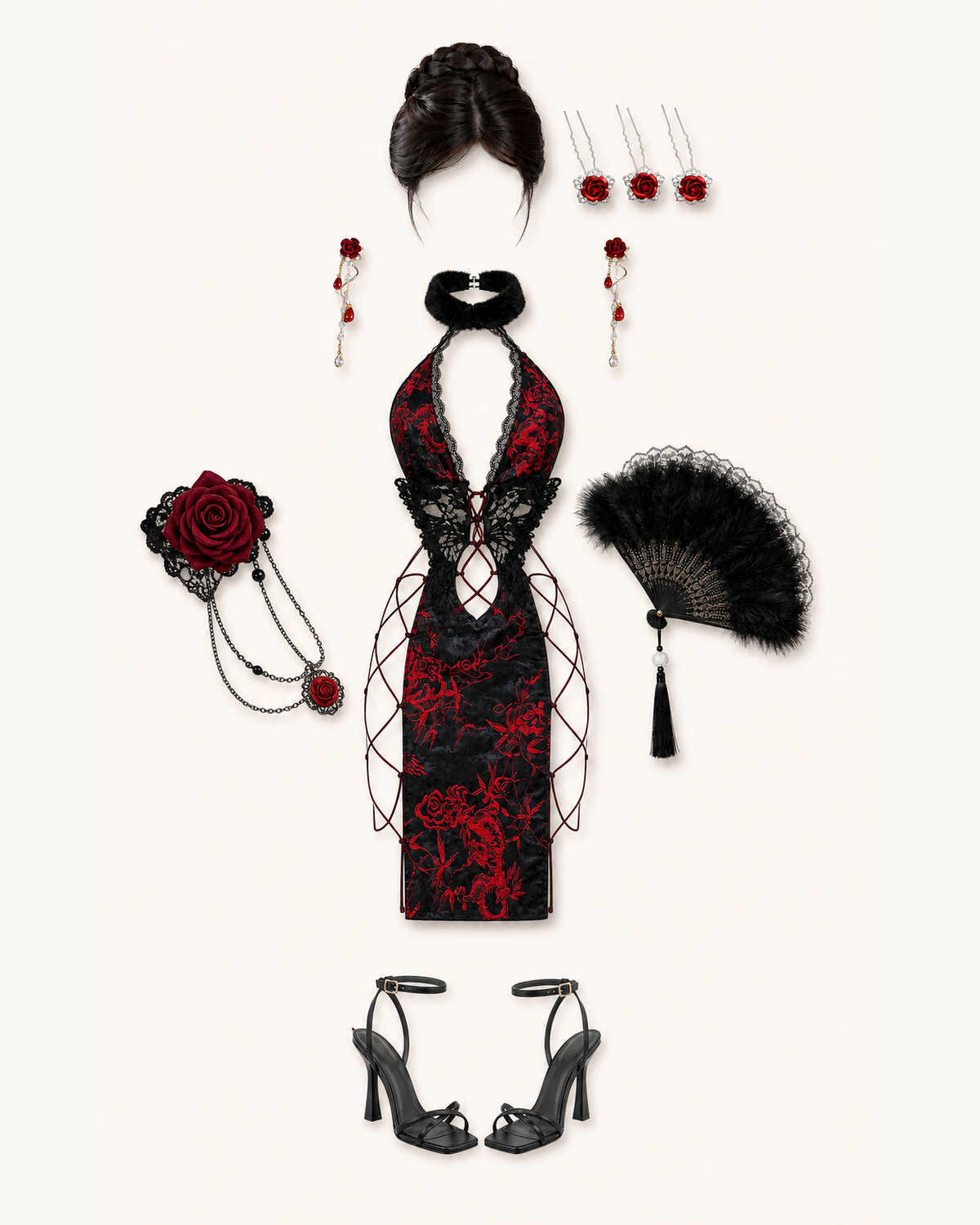
Red roses appear in several places on the Lookbook 03 board: in the dress pattern, beside the face, on the hair pins and on the hand accessory. They do not form four separate themes. The black background and repeated red shapes hold the pieces together, while the simpler shoes leave the patterned dress in charge of the lower half.
The source for this article is the styling illustration in the Your Doll Stylist Lookbook 03 delivery package. It provides a visual direction rather than proof of physical fit or a record of a customer’s purchase.
Start with the dress’s strongest features
The dress shown on the board has a black ground, red floral decoration, an open neckline and a detailed waist area. The front lacing adds fine lines beside the larger floral shapes.
There is already a great deal to read in the centre of the outfit. The surrounding pieces work by repeating some of that language rather than introducing several new colours or patterns.
For a reference brief, name the elements that matter: black and red contrast, rose motifs, the fitted outline and the detailed waist. Whether the exact construction is suitable for a particular doll requires a separate check of measurements, openings and garment information.
Repeat the rose at different scales
The floral pattern covers a larger area on the dress. The earrings use smaller rose shapes near the face. Three decorative hair pins repeat the motif at the top, while a larger rose sits on the lace hand accessory.
The sizes and positions make the repetition readable. If every rose were equally large, the accessories could compete with the dress. Here, the eye can recognise the motif without each piece demanding the same amount of attention.
The board places the pins beside the hairstyle to show the proposed components clearly. It does not establish their final position in a wig. Their attachment, weight and compatibility need checking before use; an illustration cannot answer those practical questions.
Give the face and neckline some space
The dark updo shown on the board lifts most of the hair away from the neck and shoulders. That makes the drop earrings and neckline easier to read than they would be behind a curtain of long hair.
The dark neck accessory introduces another shape near the face. In a worn view, its placement would need assessing alongside the neckline and earrings. More visible details do not automatically make the result clearer.
A useful first comparison photograph would show the upper part of the outfit without a prop crossing it. That lets you decide whether the face remains the focal point or whether the accessories need a different arrangement.
Keep the lower half quieter
The black strappy shoes on the board repeat the dominant dark colour without adding another floral pattern. Their relatively open outline also differs from the more densely decorated dress.
That contrast helps the eye separate the clothing from the footwear. It is a styling observation, not a claim that these shoes will fit every doll or provide standing support. Consult the shoe fit guide and the doll’s support instructions when considering an actual pair.
Decide what the fan should do in the photograph
The dark fan adds a broad textured shape beside the fitted dress. On the board, it is clearly separate from the clothing. In a photograph, where it is held or supported changes what remains visible.
If the purpose is to show the waist detail, keep the fan out of that area. If the fan is the focal prop, choose a composition that gives it space without losing the overall outfit. Check its edges and contact points before bringing it close to the doll or delicate clothing.
The photography styling guide provides a way to compare a first frame before adjusting the rest of the scene.
Read the combination as a complete direction
| Detail on the styling board | Visual contribution |
|---|---|
| Black dress with red floral decoration | Establishes the palette and main motif |
| Dark updo | Opens the area around the face and shoulders |
| Rose hair pins and drop earrings | Repeat the floral detail near the face |
| Dark neck accessory | Adds a separate shape above the neckline |
| Rose-and-lace hand accessory | Carries the motif into the hand area |
| Dark decorative fan | Introduces a broad prop shape beside the dress |
| Black strappy shoes | Finish the lower line with less pattern |
Use the board to make a precise request
If this direction appeals to you, tell us whether the roses, the contrast or the fitted shape is the part you want to preserve. That gives Find the Look a clearer starting point than the word “dramatic” alone.
Actual garment materials, jewellery attachments and component dimensions need product evidence. Dark textiles also require their own contact assessment; the fabric compatibility guide explains what to inspect. Confirm a complete Look’s current inclusion list before purchasing.
The idea worth carrying from this board is the relationship between the pieces: repeat one recognisable motif, vary its scale and leave enough quiet space for the main garment to remain readable.